Saturday, April 28, 2012

Twining on the commute


I am working on a twining sampler based on “Techniques of Rug Weaving” by Peter Collingwood Chapter 13 Weft Twining.

Reference book “Techniques of Rug Weaving” by Peter Collingwood
Chapter 13 Weft Twining, available for free download in PDF

Go to this page

This is 9.6 MB file is #4 out of 5 files that comprise the entire book which was posted for free download with the permission of Peter Collingwood's sons. It has clear diagrams, is available for free.

I'm working on my bus/train ride commute to work when I can tear myself away from the stupid "Solitaire" game on the cell phone.


I am also reading "The Ravens Tail" about a twined robe technique from the Pacific Northwest, an craft that is earlier than the Chilkat twined robes. It came to me in a gift box of goodies from Bonnie in Alberta, CAN. I've heard of this book and I admit that when I first skimmed through the book the hair on my neck stood up. I was electrified by the pictures. I already have some ideas for my next twining projects.

Visit Cheryl Samuel's website: http://ravenstail.com/

That's my corner of the world, Sacramento, Calif.
 
Have a good day!

Sunday, April 15, 2012

SWSG Sat April 2012


(click pictures for larger image)
The Saturday Group of Sacramento Weavers & Spinners Guild met on April 14 at Arcade Library. Our topic was "Spinning." Here's a review of our "Show & Tell" period.

On left Debra L. is blending and spinning alpaca. She has 18 alpacas and is always spinning. There is a shearing party at her place on April 29, see the Guild "Events" webpage
http://www.sacweavespin.org/events

On right Connie is showing us her brand new wheel. She bought it unassembled and unfinished. She put it together mostly by herself. She stained it blue. I think it looks warm and comfortable like a favorite pair of blue jeans. I hope she has many happy years with her new wheel.


Connie also showed us some "plarn" she spun. Plarn is "plastic yarn" spun from strips of plastic. She showed us a shopping bag she crocheted from grocery bag plarn. Connie went to the Stitches West show last month and had high praise for the show. We'll have to try that one next year.


On left Linda Y. is showing the yarn she dyed last month at our dye session. Vonnie is spinning on a supported spindle.


This is a close up of the supported spindle. The bottom sits in the little cup.


On left Cathy is spinning on her castle wheel. On right Linda S. is focusing on yarn she is spinning on a drop spindle.


Cathy brought out a shawl she is knitting and we insisted she model it. She also showed us a couple of items she is entering in a fiber show. One is a felted purse and the other is a "rug doll" named "Bigfoot". 


Linda S. showed us the yarns she has spun since her last visit with us. She is a very productive spinner.


On left Ellie is showing her knitting made from hand dyed yarn. On right Sue A. is spinning cotton on her wheel.


Sue A. also showed us the yard sale bargain she nabbed. She found a "Weave-It" loom in the box with instructions, needles, and a sample already woven for 25 cents! If you find one on Ebay plan on spending $20 plus postage.


On left Ardith is telling us about her trials with a yarn that won't come out right. She calls it "blue hairy wool." She has "un-spun" this yarn and re-spun it. Still doesn't like it. On right Stephanie is using park and draft technique on her drop spindle.


Stephanie also brought a cloth she wove with the yarn she dyed at last month's meeting. It is very soft and the stripe colors go together well. 


On left Janelle is spinning on her wheel. On right Sue W. is spinning on a wheel.


On left is guest Candace who wants to learn about weaving. She also got a chance to try spinning on the charkha. On right is guest Debra LP from San Mateo showing us the little sock loom she has been working on.


Here is a little sock she knitted and the loom she is using.


Above is an Indian box charkha (spinning wheel) that I just received as gift from Bonnie of Alberta Canada. I am showing members how the double wheel (accelerator) delivers a high ratio of twist in a small box.


 Above is Vonnie trying out the charkha.
Here is Sue W.  trying out the charkha.


It was a good day!

Schedule of future meetings:

May 19 (Sat) 1:30 pm - 5:00 pm at Fair Oaks Library
11601 Fair Oaks Boulevard , Fair Oaks , CA 95628
Same weekend as CNCH, but if you are not going there, come here!
Topic: UFO & YFH - Bring your UnFinished Objects and Yarns From Hell

June 30 (Sat) 1-5 pm At the Arcade Library
Topic: No Heddle Required: Stick Looms, Peg Looms, Twining Looms, Nail Looms
Bring your oddball little loom projects.

July 21 (Sat) 1-5 pm at the Rancho Cordova Library
9845 Folsom Blvd., Sacramento , CA 95827
Topic: To Be Determined

August 11 (Sat) 1-5 pm at the Arcade Library
Topic:TBD

Please visit the website for meeting updates
http://www.sacweavespin.org/saturday


Other links of interest:
Purlescence Yarns, Sunnyvale, Calif
http://purlescenceyarns.com/

Stitches West
http://www.knittinguniverse.com/STITCHES/


Sunday, April 1, 2012

Steelhead Trout Release


This is the insulated refrigerated tank in the 2nd Grade classroom where my lovely wife teaches. This is where the steelhead trout eggs hatched on the blue gravel and they grew into smolts, about a half to three quarter inch long.


Time for the little smolts to go to the American River. There they will grow and drift down to the Pacific Ocean.


Here are the smolts in a container ready for the trip to the river. The blue gravel from their tank was captured in the little net when we scooped the fish out of the tank.


Here is Franco pouring the fish into the river as a couple of local boys look on. Hopefully the smolts will hide under the log and the rocks, then start working their way down the river. With luck, they will go to the ocean and come back to this river to spawn (reproduce).


That red arrow points to a little shadow where one of the smolts is. The rest are hiding under the log and rocks. The blue gravel marks the spot where they were poured into the water, near the Howe Ave Bridge, American River, Sacramento, Calif.

It was a good day!

Sunday, March 25, 2012

Bike and Basket Book


A couple of surprises last week. On the way to work I saw this bicycle with a cover that makes it more aerodynamic. Rolling down the road near 7th and K St.


 I have been looking for a newsletter from the 1970s called "Threads In Action" edited by Virginia Harvey. (See blog entry "Threads In Action") Then Diana from Bend, Oregon told me she has a book that needs a new home. I received in the mail "The Techniques of Basketry" by Virginia I. Harvey. I've already read it from cover to cover.


Lots of pictures, patterns and structures. I've been looking for more information on twining, and wickerwork. Looking for info on coiled basketry. Now I feel like I've taken an introductory course in basketry and textiles. Techniques of basketry are universal in human development and history. Already I'm looking differently at the structure of rugs, baskets, and everything. I think that is an indication of how good a book is. When it changes how one looks at things. I am becoming a fan of Virginia Harvey.

Have a good day!

Tuesday, March 20, 2012

1st Day of Spring - Turkey Vulture Play Day


(Click pictures for larger image)
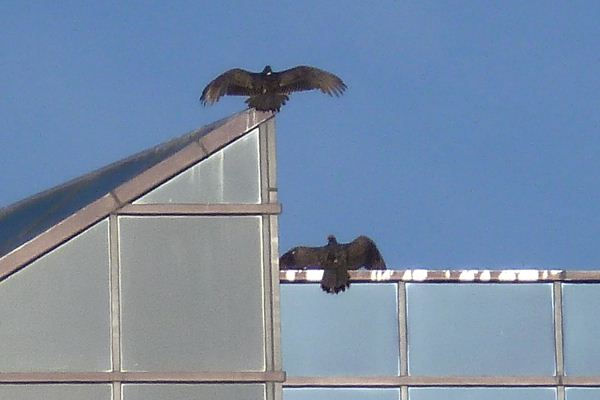
 First day of Spring! The Renaissance Tower in Sacramento, Calif, reaches 372 ft. into the sky like a dark glass cliff. The only cliff like thing for miles around on this floodplain. The dark face creates updrafts for soaring. And the turkey vultures come out to play! (see dark spots in the sky)


There is lots of circling in the updrafts from the face of the building.


Lots of circling. It's a turkey vulture party!


Big bird soaring with a six foot wingspan.


A couple of big birds sunning themselves at 370+ feet!


A bird flies into side of the building because its like a mirror. Or maybe because it is like a party.

Turkey Vultures stay here all year long but a clear sunny day is special.

From my corner of the world, Sacramento, Calif.

Have a good day!


Sunday, March 11, 2012

SWSG March Dye Meeting


(click pictures on blog for larger image)
For March, the Saturday Group of Sacramento Weavers and Spinners Guild met at the home of member Cathy Sweeney for a dye session.


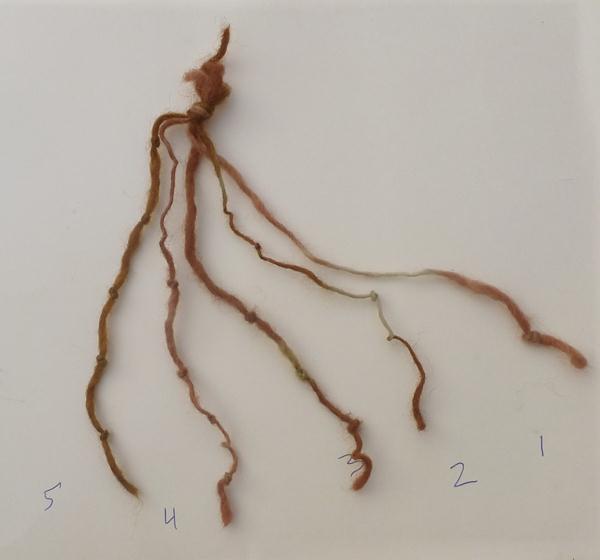
Here is Sue, Connie, Linda and Sara are tying up some samples of wool yarn that has been pre-treated with different mordants. Five knots is tin. Four knots is iron. Three knots is copper. Two knots is chrome.  One knot is untreated. They will be put into the dye pots so we can see how the mordants react differently in the same dye.


 EDITED TO ADD: Here is a mordant test bundle I brought home. There is a difference in color with the same dye, different mordant chemicals. From left to right: Tin, Iron, Copper, Chrome, Untreated.


Goldfinches visit one of the bird feeders.


The pots are set and we wait for the water to heat up. Notice the empty rack on the left. That will become a very busy piece of equipment.


One of pots has California Native Black Walnut husk, another has Silver Dollar Eucalyptus, another pot has Oak Galls from Valley Oak trees,


We had a pot of Red Onion skins and another pot of Marigold flowers (not shown).


Cathy has a lot of reference books, she has mordants, she has propane stoves, and most importantly, she has gloves to prevent your hands from turning colors.


Cathy also keeps a scrapbook that has index cards with snips of yarn samples from dying so she can repeat a process when a certain color is desired. We loaded up the pots with our yarn samples and let them set.


While waiting for the pots to set the color on our yarns  we waited. We chatted about projects we are working on and are planning. And I enjoyed looking at the flowers. I need some of these to plant next to the condo.


We also played with Kool-Aid softdrink mix powder and liquid food colors in mason jars. Koolaid is a popular dye that is inexpensive and non-toxic.


Here is the result of Strawberry Koolaid and Cherry Koolaid as dye. Notice how pale the liquid is now that the color has been drawn into the yarn. That is called "exhausting" the dye.


This Cooper's Hawk is a local resident and kept flying over the area.


Cathy shows off a purse that she knitted then over-dyed with Madder root which is a strong red dye. She says the upper part of the bag was light green like the yarn in the handle but the Madder changed it to this dark brick color.


Cathy pulls up the yarn that was sitting in the jars with koolaid, making a multi-colored skein.


Here I am with Stephanie fishing out a skein from the pot of marigold flowers.


It was a beautiful day. Overhead there is a flight of Sandhill Cranes, big birds with big booming calls.


Here we have yarns drying on the rack. Most of them went into the natural dye pots, with a few colored with koolaid.


This is my little set of  five samples. I used bright white cotton yarn. From left to right, Onion, Eucalyptus, Black Walnut, Oak Galls, Marigolds. They will be washed later. I plan to weave them into a sampler for display.


EDITED TO ADD: This is my little set of  samples after washing in cold water. From left to right, Onion, Eucalyptus, Black Walnut, Oak Galls, Marigolds, Indigo, and the mordant test bundle.


Loading up the rack with so much! I'm surprised it did not collapse!


With the natural dyes all done, Cathy started a pot of Indigo dye, which is a very strong blue dye. Here is Nancy in the straw hat, Sue in the red apron, and our youngest Saturday Guild member, Ellie, is winding yarn on a niddy noddy for a skein to dip into the indigo.


This is the pot of indigo. In a process not well understood by me, the oxygen is displaced from the liquid before dipping the yarn in for dying. Care has to be taken not to stir, or drop yarn too quickly so as not to introduce air bubbles into the liquid.


As we waited for things to drip dry the birds provided lots of entertainment. Here is a crow chasing a hawk.


Here are some of the items that were dipped into the indigo dye. The color develops as the yarn is exposed to air after dipping. Some of the yarns are dipped more than once. The bottom left is raw wool that was dyed in mesh bags. The skein to the left center of the picture with the purple and blue color is the skein that was koolaid dyed with red yellow and blue. Cathy overdyed it with the indigo!


Here is one members bundle of skeins. Sorry about the funny lighting but it was a nice bunch of yarns.

Not shown was the lunch which was pot luck with everybody bringing something. We had thirteen people in attendance with a couple of guests and new members.


Our next Saturday meeting will be
April 14 (Sat), 10 am - 12:30 pm At the Arcade Library
Spinning! Bring your spinning to show off!

Visit the Sacramento Weavers and Spinners Guild website for schedules
http://www.sacweavespin.org/saturday

I want to thank Cathy Sweeny for a wonderful time playing with dyes. One of the best things about being with the Guild are the members who are willing to share their knowledge and experience.

It was a good day!