Showing posts with label cricket. Show all posts

Sunday, April 25, 2010

Clasped Weft


Continuing the sampler weft from the class I took at CNCH.

One of the techniques practiced at Syne Mitchell's class was Clasped Weft. A weft comes from the right side, grabs another weft from the left and pulls into the middle. Loom is a Schacht Cricket. The Clasped Weft has two wefts in each pick so the weft color dominates. My camera is still failing me, so I will describe.

The pink weft from the right goes through the shed to the other side. The pink now grabs a loop from the blue and pulls across to the middle. By moving the meeting point you can change the spot where color change happens. Because of the two threads looping each other there is usually a bump where the two wefts meet.


As you can see, I kind of fooled around with placement of color. I had to change a weft in the pink and that is the two ends you see that have popped up. After I wash this piece I will clip those threads off. The left edge selvedge is fairly straight, but I am having a bad time with the right edge. Somehow the warp got loose on about twelve threads.


I have pushed a ball point pen onto the back beam to take up some of the looseness. It helps, but I may need to put a thicker pen for the next round. I will be weaving about 10 inches of each technique until I get to the end of the warp.

Have a good day!

Thursday, April 15, 2010

CNCH Rigid Heddle Sampler


(click pictures for larger image)
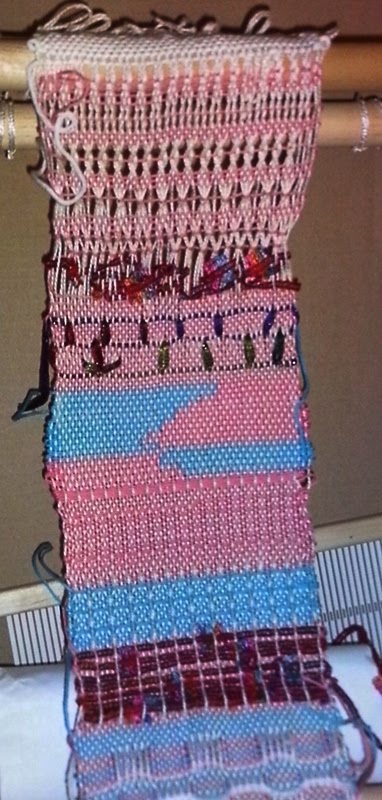
This is the sampler I wove in Syne Mitchell's class at Conference of Northern Calif Handweavers conference at Santa Clara. The class was called "Rigid Heddle: Beyond Plain Weave"

We were told to bring a rigid heddle loom warped with 3/2 perle cotton on a 12 dent heddle or whatever we have, 8 dent with worsted yarn is fine too. I warped up with 3/2 cotton. Loom is a Schacht Cricket.

I used a #3 crochet yarn as weft. I just grabbed these colors since they were the right size and looked like they would go together. One of the other weavers called it the "Hello Kitty" sampler.

Syne is a very good teacher. The mistakes in the weaving were all my fault, not a reflection on the skills of the teacher.


Syne started with Leno lace and Brooks Bouquet which are weaver manipulated weaves. The split level bouquet is a variation I haven't seen before and I think I want to try that. The Spanish Lace is badly done, but that's my fault, not Syne's. I included a picture below of Linda's Spanish lace which looked like it is supposed to.

The clasped weft is easy and fun. The sides are kind of loopy, but I was trying get a feel for how much weft to weave in.


This is Linda's Spanish Lace with ribbon which looks like it is supposed to. Linda also has some Brooks Bouquet at bottom of picture done every four strands and in middle of picture is Brooks Bouquet again as intermittent accent.

This next group is made up with pick up technique. The trick is to pick up warps from behind the heddle with the heddle down and only warps in slots, not holes.

The warp float mistake is what happens when you leave the heddle up for pickup. It doesn't look that bad actually. It could be a feature in another piece.

The next item is Warp Float Lace, 1 warp up/1 warp down.

Window Pane is same but 1 warp up/2 warp down.

The warp float lace won't look right until it's wet finished. I have a couple more yards of warp to weave before I cut it off and wash it.

Next is a supplemental weft technique using extra yarn for added interest. The extra yarn is laid down under the warp floats (1 up/2 down).

The Honeycomb technique uses 5 up/5 down with a thicker supplementary weft yarn inserted.

So these the techniques beyond plainweave and I'll be practicing in the future.

That's all for now.
Have a good day!

Saturday, January 9, 2010

Autumn/Taupe Scarf Finished


Here it is! (click on picture for larger image) 80 inch long including 3 long fringe, 4-1/4 inch wide. Loom is a Schacht Cricket. The horizontal stripe pattern carried all the way through even as the warp colors changed from the variegated yarn. When I am weaving I am focused on a small section of the piece, so I was pleasantly suprised with how well the color changes worked in the complete piece. No so much because I'm good, but because the yarn designer did a good job with the color changes.


When I set up the warp, I took advantage of the placement of the 9 inch long yellow sections in the yarn. I made sure I had yellow in the fringe area on each end of the scarf. So I was able to braid yellow with a contrasting color for the end treatment.


I braided the scarf on the loom, it's just easier to control things that way. After cutting, braiding the first end, remove the heddle then wind the scarf onto the beam to get back to the beginning. Then cut, braid and finish the second end.

The color and horizontal stripe pattern has a "native" feel to it so I thought braids would look better than twisted fringe. The fringe looks good, I need more practice to make the ends even. 3 inch long, knotted, then trim yarn 1/4 inch.

To see first part of this scarf project see Autumn/Taupe Narrow Scarf


Have a good day!

Saturday, November 14, 2009

Black/Purple log cabin weave


Here is my next log cabin scarf in progress with the other two colors of wool yarn, the black and the purple. (Click on picture for larger view)

The color pattern is very subtle. I am having trouble keeping track of my color changes and you can see where I missed a color change (purple instead of black at change).

I am weaving under the best light in the kitchen in the evening, but today is with all the windows open for light.

I know it is going to look great when when its done.

Have a good day!

Wednesday, November 11, 2009

Finished Log Cabin Scarf


Here is the finished log cabin scarf! (click picture for larger image)

I hand washed it in lukewarm water with Woolite soap to set the wool and to full it a little bit. I gently squeezed the fabric in the soapy water for about 15 minutes, then rinsed it through two changes of lukewarm water. I was surprise how cloudy the water became, I think there is some sizing or starch in the wool yarn.

I squeezed out the water, do not wring, then rolled it in a towel to absorb most of the moisture, then remove from towel. drape the damp scarf over the back of a chair and let it sit overnight. Trim off the extra bits of yarn and the tips of the fringe. It's finished!

Many thanks to Claudia at Weavolution.com for suggesting this pattern for a Weave-A-Long group weaving project.

Now on to the next one!
Have a good day!